
English
Views: 0 Author: Site Editor Publish Time: 2026-09-02 Origin: Site
Selecting industrial cleaning equipment requires balancing upfront capital expenditure against long-term labor efficiency. We face operational realities daily when managing facility maintenance. Over-investing in a massive ride-on machine severely limits maneuverability in tight aisles. Conversely, under-investing by relying solely on a basic Hand Push Floor Scrubber leads to high labor costs and rapid operator fatigue. Facility managers must avoid both extremes to optimize their cleaning operations.
This guide provides a purely objective, criteria-driven framework. We will help you choose between a hand-push and a ride-on floor scrubber. The final decision depends heavily on facility size, specific layout constraints, and financial variables. You will learn how to evaluate aisle width, battery requirements, and safe storage limits.
Understanding these variables prevents costly procurement mistakes. We break down every crucial factor below. You can confidently select the right machine to match your specific facility needs.
Size Thresholds: A hand push floor scrubber is typically optimal for facilities under 30,000 to 50,000 square feet, whereas ride-ons yield ROI primarily in spaces exceeding 50,000 square feet.
Maneuverability vs. Speed: Hand-push models navigate narrow aisles and congested areas efficiently; ride-on models maximize cleaning speed but require wide turning radii.
Cost Dynamics: Ride-ons carry a significantly higher initial purchase price but can offset costs through labor savings in large-scale operations.
Infrastructure Needs: Ride-ons require dedicated, ventilated charging stations and substantial storage space compared to the compact footprint of hand-push units.
You must understand the core mechanical differences before evaluating your facility. Each machine type serves a distinct operational purpose. They utilize different propulsion methods and structural designs.
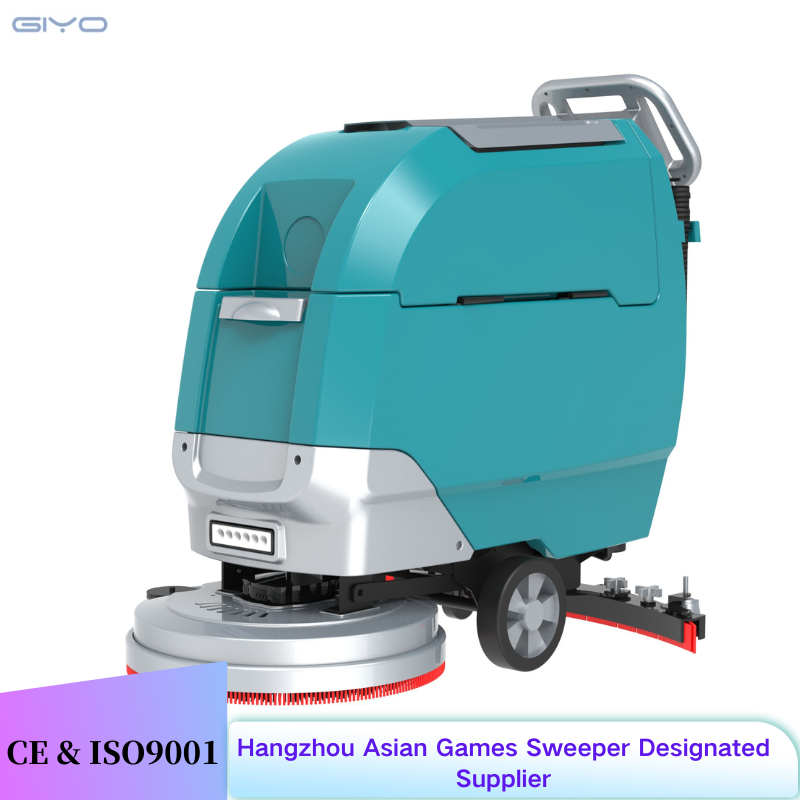
Operators walk directly behind this equipment. They physically push the machine forward. Many modern units utilize a pad-assist design. The friction of the rotating cleaning brush naturally pulls the unit forward. Larger versions feature a dedicated traction drive system. A separate motor propels the machine, reducing physical strain.
Engineers design these machines for localized cleaning. They excel in tight corners. You can easily navigate them around active foot traffic. Retail stores, hospitals, and moderately sized schools rely heavily on them. They clean effectively without disrupting daily operations.
Operators sit or stand on these machines. They steer them similarly to a small vehicle. Ride-on models feature high-capacity water tanks. They boast significantly wider scrub paths. Operators can clean massive areas for prolonged periods without experiencing physical exhaustion.
These machines dominate large-scale environments. Warehouses, airport terminals, and expansive manufacturing plants utilize them daily. They maximize cleaning speed across wide, unobstructed spaces.
A larger machine is not inherently superior. The "better" machine depends entirely on matching equipment throughput with your specific layout. You must align the machine's capabilities with your available labor model. Buying a massive ride-on for a congested grocery store creates operational bottlenecks. Conversely, using a compact Hand Push Floor Scrubber in a massive distribution center wastes valuable labor hours. Success means finding the perfect intersection of size, speed, and agility.
Square footage dictates your baseline equipment needs. However, layout complexity ultimately determines the final choice. You must evaluate both factors together.
Industry standards provide clear recommendations based on facility size. We rely on these proven benchmarks to guide procurement.
Under 30,000 sq. ft.: Hand push models are highly recommended. A single operator can easily clean this area during a standard shift. The initial investment remains low.
30,000 – 50,000 sq. ft.: We call this the gray zone. Your decision relies heavily on layout complexity. An open gymnasium favors a small ride-on. A congested grocery store of the same size demands a hand-push unit.
50,000+ sq. ft.: Ride-on scrubbers become mathematically necessary here. They help you maintain acceptable labor hours. Attempting to clean this expanse manually leads to severe inefficiencies.
You must assess turning radius requirements carefully. Ride-ons struggle significantly in narrow warehouse aisles. Standard Very Narrow Aisle (VNA) layouts restrict their movement. They also perform poorly in congested retail spaces. An operator might get stuck or damage racking systems.
Hand push units excel in spaces featuring changing floor plans. They easily handle frequent obstacles. You can maneuver them through standard commercial doorways. They clean tightly around end-caps and production machinery.
Heavy equipment poses unique infrastructure challenges. You must note weight limits on freight elevators. Mezzanine levels frequently disqualify heavier ride-on units. A fully loaded ride-on scrubber can exceed structural weight capacities.
Evaluate your ramp gradients carefully. Powered hand push scrubbers handle moderate inclines safely. Top-heavy ride-ons pose tipping hazards on steep ramps. Always verify the manufacturer's maximum incline rating before operating equipment on grades.
Table 1: Layout Compatibility Matrix
Facility Characteristic | Hand Push Scrubber | Ride-On Scrubber |
|---|---|---|
Narrow Aisles (< 6 feet) | Highly Compatible | Incompatible |
Frequent Obstacles | Excellent Maneuverability | Poor Maneuverability |
Multi-Level (Elevator Use) | Standard Access | Weight/Size Restricted |
Wide Open Spaces | Inefficient (Slow) | Highly Efficient |
Procurement requires evaluating both the initial machine price and ongoing operational variables. A cheaper machine might cost you significantly more in daily wages. You must balance these financial factors.
Contrast the baseline equipment costs directly. Hand push floor scrubbers offer a much lower barrier to entry. They usually require less capital budget. Managers secure procurement approval for them much faster. Smaller businesses prefer this lower initial hit to their cash flow.
Ride-on machines require substantial upfront investment. You are purchasing a drivable vehicle with complex electronics. The approval process often involves upper management and detailed financial justification.
We must break down hourly productivity strictly. According to ISSA (International Sanitary Supply Association) cleaning standards, a ride-on can cover 30,000 or more square feet per hour. A hand-push model averages between 10,000 and 20,000 square feet per hour.
Emphasize one critical industry fact: labor typically constitutes 80 to 90 percent of total cleaning expenses. If a ride-on machine saves your staff 15 hours of labor per week, you reach a break-even point quickly. You can reassign those saved hours to other profitable tasks. Speed directly translates into payroll savings.
Machines require constant upkeep. Ride-ons possess complex drive motors. They feature detailed steering columns and massive battery banks. These components lead to higher preventative maintenance costs. When they break, you usually need specialized technicians to fix them.
Hand-push models feature far fewer moving parts. They simplify in-house repairs drastically. Your maintenance team can replace squeegees and brushes in minutes. This simplicity reduces overall equipment downtime.
Employee well-being directly impacts your operational success. Cleaning machines interact constantly with your workforce. You must evaluate the physical demands placed on your operators.
Continuous manual operation over large areas demands physical exertion. Operating a hand push scrubber for eight hours causes significant operator fatigue. This exhaustion impacts cleaning consistency toward the end of a shift. It also lowers overall worker retention rates. Employees easily burn out from the constant walking.
Ride-on machines eliminate this walking entirely. Operators remain comfortable. They maintain high productivity levels from the beginning to the end of their shifts.
Ride-ons offer higher seating, improving forward visibility. However, they introduce serious kinetic risks. They move faster and carry more mass. This increases the severity of accidental collisions. Operators might strike inventory, storage racking, or passing personnel. Blind spots exist near the floor level.
Hand push units keep the operator securely grounded. They walk at a natural pace. This offers immediate reaction time in high-traffic zones. Hospitals and retail stores heavily prefer grounded operators during business hours. They can stop instantly if a customer steps into the aisle.
Complex machinery requires formal instruction. Ride-on scrubbers demand rigorous safety training. You must document this instruction clearly. Your site might even require specific internal certifications before an employee can drive the machine. You treat it similarly to a forklift.
Hand-push units feature a much gentler learning curve. You can train a new employee to use one in less than an hour. The controls remain intuitive and straightforward.
Buying a machine solves your floor cleaning problem. However, it introduces new storage and facility requirements. You must prepare your building for the equipment.
Ride-on scrubbers demand dedicated parking bays. These areas must not obstruct daily operations. You cannot simply leave them in an active hallway. They take up space equivalent to a small golf cart.
Hand-push units maintain a highly compact footprint. You can easily store them in standard janitorial closets. They fit neatly alongside mop buckets and supply shelves. This saves valuable commercial floor space.
Large machines need serious power. Ride-ons typically use massive lead-acid or AGM battery banks. Charging these batteries requires strict facility compliance. You must provide adequate room ventilation to prevent gas buildup. You need emergency spill kits nearby. They often require dedicated high-voltage electrical circuits.
Hand-push models utilize much smaller battery packs. Many modern units feature advanced lithium-ion options. These plug safely into standard 110V or 220V wall outlets. They require virtually zero facility modifications. You can charge them in almost any standard room.
Best Practice: Always consult your local fire codes regarding indoor battery charging stations before purchasing a large ride-on scrubber.
We created a straightforward, four-step process. Follow these steps to eliminate guesswork. This framework ensures you purchase exactly what your facility requires.
Do not simply look at your total building size. You must measure the actual cleanable square footage. Subtract the space taken by storage racks, fixed machinery, and office walls. A 100,000-square-foot warehouse might only have 30,000 square feet of cleanable aisles. Base your decision solely on the cleanable area.
Examine your current workforce structure. Do you employ dedicated cleaning staff? Or do your warehouse employees clean as a secondary task at the end of their shift? If cleaning is a secondary task, speed becomes paramount. You need the fastest machine possible to let employees return to their primary duties.
Never buy industrial equipment purely from a catalog. Insist on a comprehensive on-site demonstration. Test the machine in your tightest aisle. Evaluate its turning radius firsthand. Check its edge-cleaning capabilities against your specific baseboards. Ask your primary operators to test it for comfort.
Look beyond the initial sticker price. Compare the equipment quote against the projected labor hours you will save. Calculate how many hours a ride-on saves per week compared to a manual push model. Multiply that by your hourly wage over three years. If the labor savings exceed the higher machine cost, the upgrade makes complete financial sense.
Choosing the correct equipment relies entirely on evaluating your unique facility profile. Buy a hand push floor scrubber for maximum agility, navigating tight layouts, and maintaining budget-conscious capital expenditure. Buy a ride-on unit for massive open spaces where significant labor savings quickly offset the high initial investment.
Carefully weigh aisle widths against square footage. Do not ignore the hidden infrastructure requirements of charging heavy batteries. An oversized machine causes property damage, while an undersized machine inflates payroll.
We strongly recommend scheduling an on-site facility audit immediately. Contact a qualified equipment distributor today. They can calculate your exact projected labor savings and determine the most appropriate scrub path width for your floors.
A: "Auto scrubber" is simply a blanket industry term. It refers to any automated floor cleaning machine that dispenses water, scrubs, and vacuums it back up simultaneously. This broad category includes both hand-push (walk-behind) variants and larger ride-on models.
A: No. Scrubbers primarily use water and rubber squeegees to remove fine dirt and liquid spills. If you attempt to vacuum up heavy solid debris, you will clog the vacuum hose and damage the squeegee blade. You must use a sweeper-scrubber combo or pre-sweep the floor manually.
A: You can typically expect 2 to 4 hours of continuous runtime on a single charge. This depends heavily on the battery type (lead-acid vs. lithium-ion) and the floor surface friction. Rough concrete drains batteries significantly faster than smooth polished epoxy.
A: A basic pad-assist model is perfectly fine for flat, highly smooth surfaces. However, we highly recommend a traction-drive system for ramps, uneven industrial floors, or thick carpets. The dedicated drive motor prevents severe operator exertion and lowers the risk of physical injury.
